


Ulaanbaatar, Mongolia | 21 August 2026
By Benjamin Abugri, FARA
The Forum for Agricultural Research in Africa (FARA) has called for a fundamental shift in how research is designed, communicated and translated into action, stressing that knowledge management must be treated as an integral part of the infrastructure for achieving research impact rather than an end-of-project dissemination function.
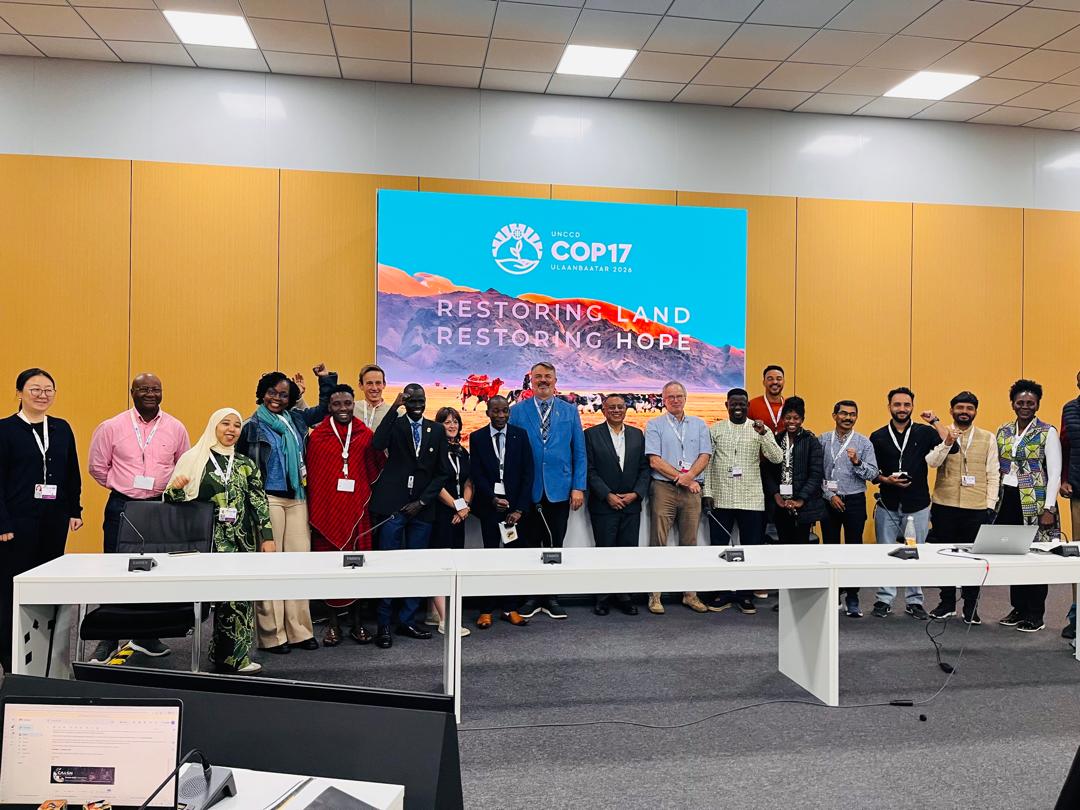
The call was made during the INTERFACES side event at the 17th Conference of the Parties to the United Nations Convention to Combat Desertification (UNCCD COP17) in Ulaanbaatar, Mongolia. The session, titled “From Research to Reality: Developing Innovations for Reconciling Food Security and Sustainable Land Management in Sub-Saharan Africa,” brought together researchers, development practitioners, policymakers and other stakeholders to examine how innovations and research findings can more effectively contribute to sustainable land management and food security in Africa.
The side event formed part of the wider work of INTERFACES – Supporting Pathways to Sustainable Land Management in Africa, which supports regional research and development projects through networking, science communication, social learning, capacity development and approaches for strengthening the relevance and uptake of research findings.
Moving research from outputs to impact
Speaking as a panellist from the perspective of practice and knowledge management, Benjamin Abugri of FARA argued that the persistent gap between research and reality is not necessarily caused by a shortage of research findings. Rather, greater attention is needed to the relationships, translation mechanisms, learning processes and institutional ownership through which evidence becomes relevant to decisions and sustained practice.
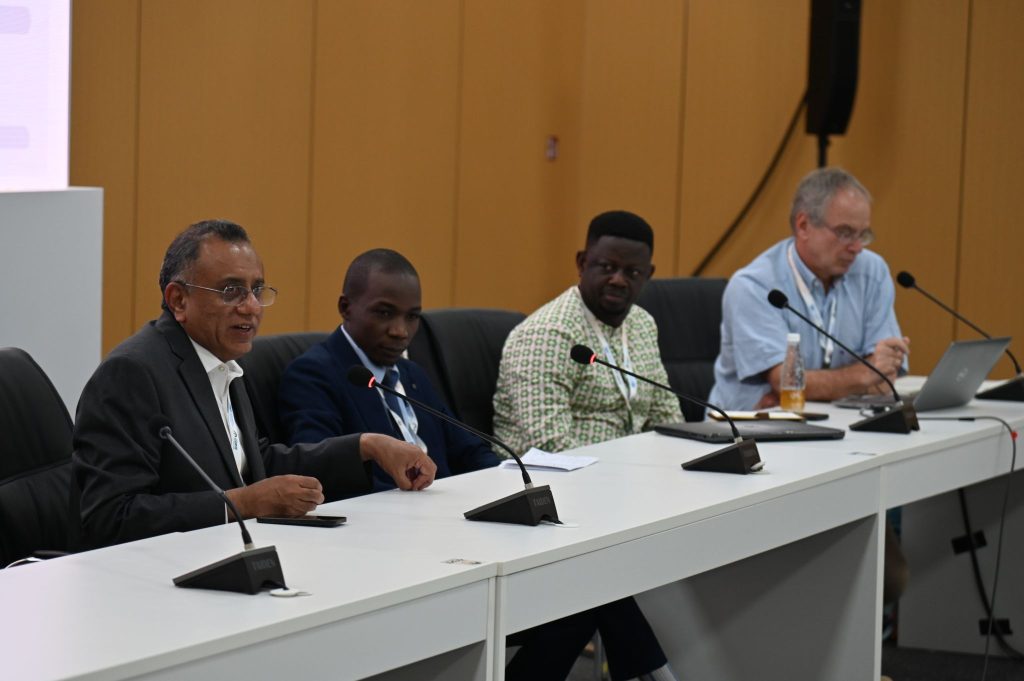
Mr. Benjamin Abugri, FARA’s Knowledge Management, Digitalization & Leanring Cluster Lead (third from the left)
“A research output can be delivered. Impact must be negotiated, learned and owned.”
He noted that addressing interconnected challenges such as land degradation and food insecurity requires moving beyond approaches in which researchers define problems, conduct research and only engage intended users when findings are ready for dissemination.
Instead, research should be designed for use from the beginning. Farmers, extension professionals, policymakers, traditional authorities, women, young people, researchers, private-sector actors and other stakeholders should be engaged as knowledge partners who help shape research questions, interpret evidence, test assumptions and determine how innovations can work within their specific contexts.
This also requires knowledge management and science communication to be adequately resourced from the outset, with clear responsibilities, deliverables and pathways for sustaining knowledge and relationships beyond the life of individual projects.
Bringing FARA’s knowledge ecosystem to INTERFACES
Drawing on FARA’s experience within INTERFACES, Abugri highlighted the organisation’s role in helping different forms of knowledge meet, become visible and travel responsibly across networks.
FARA brought its wider knowledge ecosystem to bear on the project, including the Knowledge Management for Agricultural Development (KM4AgD) agenda and Community of Practice, knowledge platforms and hubs, knowledge products, learning events and professional communities.
Together, these mechanisms provided multiple pathways through which research evidence, practical experience and lessons generated through INTERFACES could be documented, discussed, translated and connected to wider agricultural research and innovation communities across Africa.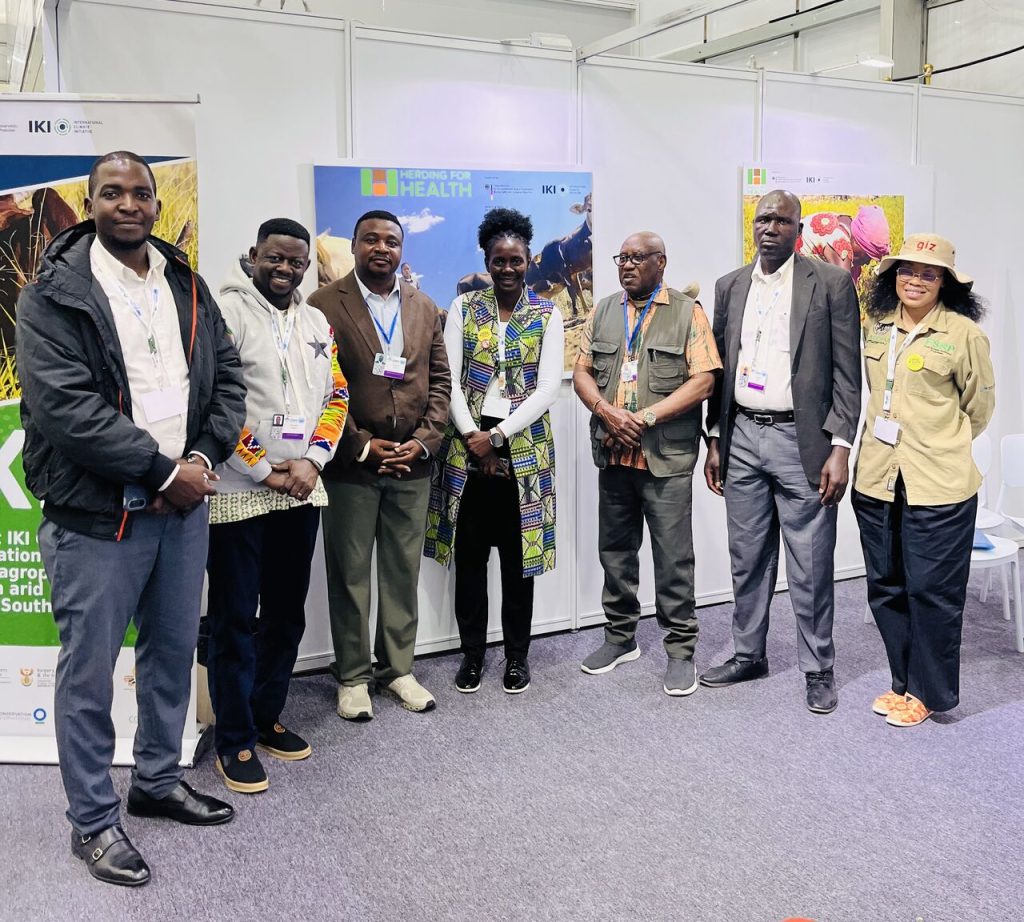
FARA’s contribution to INTERFACES has included science communication, networking, stakeholder engagement and knowledge management. Through seminars, colloquia, webinars, knowledge products, media documentation, communities of practice, the sustainable land management e-certificate initiative, the KM4AgD Challenge and participation in strategic continental and international events, project learning has been connected to wider conversations on sustainable land management and agricultural transformation.
The approach reflects a broader understanding that effective knowledge exchange is not simply about making information available. It requires a connected knowledge ecosystem in which scientific evidence, practical experience and local knowledge can interact, be contextualised and translated into forms relevant to different users.
Ghana Participatory Learning Platform demonstrates value of co-creation
The Ghana Participatory Learning Platform (PLP) was highlighted as a practical example of this approach.
Established in November 2023, the Platform has brought together farmers, researchers, agricultural extension officers, policymakers, traditional leaders, civil society, development practitioners and other actors within a recurring space for dialogue and collaborative learning around sustainable land management.
Rather than treating communities as recipients of completed research, the PLP provided opportunities for actors to jointly interpret evidence, surface local priorities and bring scientific knowledge into conversation with farmers’ experiences and the social, cultural and institutional realities surrounding land management.
The value of this approach was reinforced during the INTERFACES validation and exit process in Tamale in July 2026. Stakeholders concluded that the Platform had demonstrated sufficient value to warrant continuation and possible replication, while stressing that its sustainability would require deliberate institutional ownership, continued facilitation and integration into existing programmes and institutions.
The experience also demonstrated why traditional authorities and other community actors must be engaged throughout the research and innovation process. Land-management decisions are not purely technical; they are influenced by customary authority, livelihoods, gender relations, access to resources, trust and local power dynamics.
Standardise learning, localise knowledge processes
Addressing the challenge of applying knowledge-management approaches across different countries and contexts, Abugri cautioned against assuming that successful approaches can simply be replicated in identical forms.
“Standardise the learning architecture; localise the knowledge process.”
Continental and multi-country initiatives can maintain common principles such as theories of change, documentation standards, ethical data practices, learning questions and mechanisms for comparing experiences. However, the way knowledge is generated, exchanged and applied should reflect local languages, communication channels, trusted intermediaries, institutional arrangements, incentives and social realities.
Scaling, therefore, should not mean reproducing a fixed technical package everywhere. What can travel more effectively are the underlying principles and processes – inclusive diagnosis, co-creation, local testing, feedback, documentation, learning and institutional embedding – while allowing adaptation to specific contexts.
This also requires recognising plural knowledge systems. Scientific evidence remains essential, but so too are farmers’ practical experience, traditional knowledge, customary institutions and the lived realities that determine whether an innovation is feasible, trusted and sustainable.
Knowledge management as impact infrastructure
The session also provided an opportunity to reposition knowledge management from an information-storage function to a strategic driver of research impact.
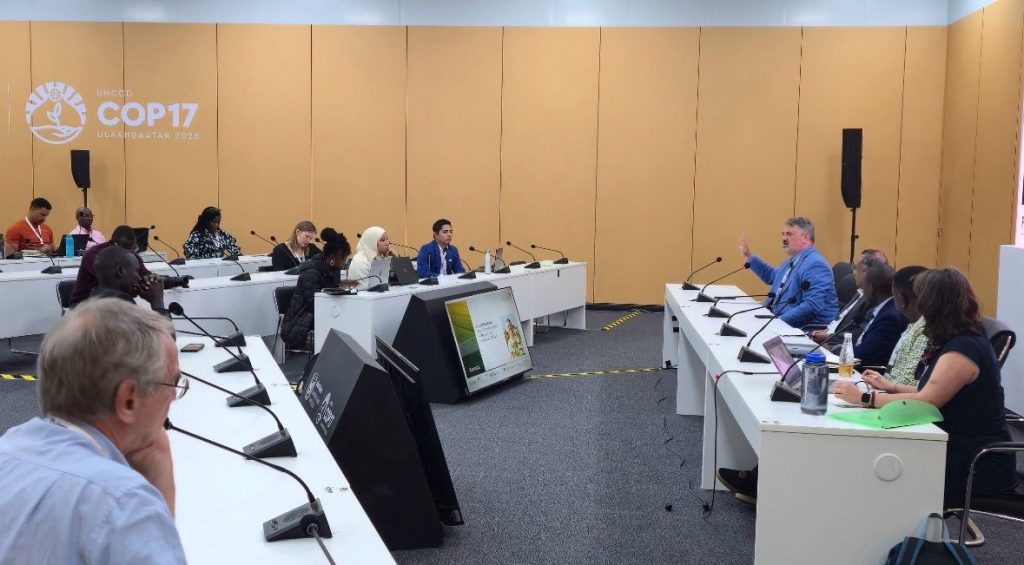
FARA’s experience suggests that effective knowledge management performs at least four interconnected functions: connecting actors, enabling collective sense-making of evidence, translating knowledge into usable formats, and preserving learning and relationships beyond individual project cycles.
Participatory platforms and communities of practice can therefore be as important to the impact pathway as repositories and knowledge products.
Digital platforms remain essential for preserving information, extending reach and enabling access. However, their value depends on their connection to active communities, trusted knowledge curation and actual decision-making processes.
“Storage preserves information; stewardship makes it usable.”
Rethinking how research enters policy
Another key message from the discussion was the need to move away from the traditional linear pathway of research → publication → dissemination → policy uptake.
Instead, research-to-policy engagement should operate as a continuous interface in which policymakers, practitioners and communities contribute to framing research questions and have opportunities to engage with emerging evidence throughout the research process.
Research findings also need to be translated into actual policy and implementation decisions. Policymakers may not always require lengthy technical reports. Depending on the issue and policy window, they may need concise options papers, evidence on costs and risks, maps, implementation guidance, training materials or credible accounts of community experience.
This makes knowledge brokerage particularly important. Institutions and individuals are needed to convene stakeholders, translate across professional and knowledge systems, maintain evidence bases and support learning as circumstances change.
The central lesson is that evidence does not enter policy through publication alone; it moves through timing, trust, translation and institutional ownership.
Diverse perspectives enrich the discussion
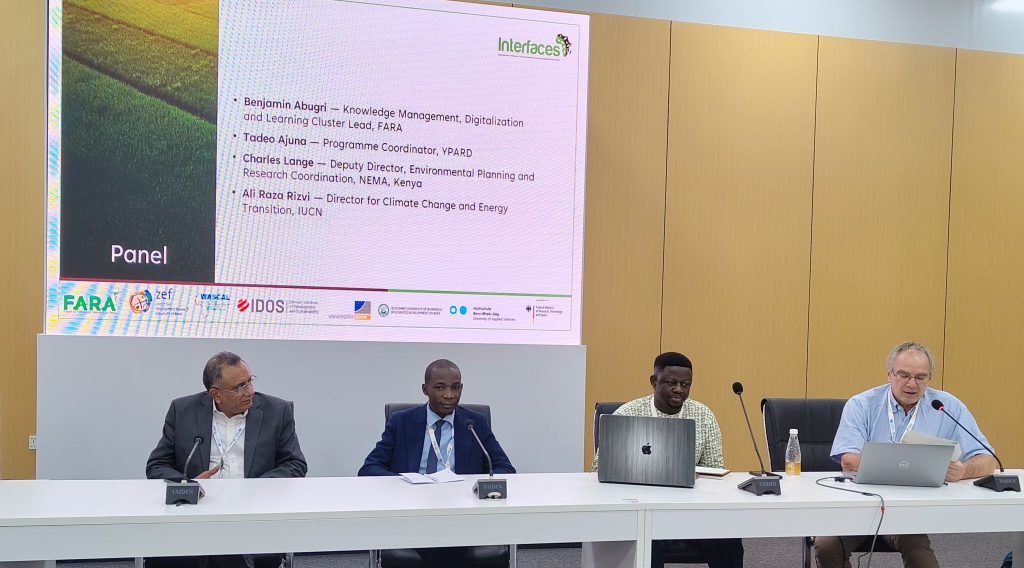
Ali Raza Rizvi, IUCN; Tadeo Ajuna, YPARD Uganda; Benjamin Abugri, FARA; and Michael Bruentrup, IDOS (from left to right)
The session featured Dr Stanford Blade, Deputy Director General for Research and Innovation at CGIAR-ICRISAT, who delivered the keynote address, alongside panellists Ali Raza Rizvi, IUCN Director for Climate Change and Energy Transition; Tadeo Ajuna, YPARD Country Representative for Uganda; and Benjamin Abugri of FARA.
The discussion was moderated by Aiveen Donnelly and Michael Brüntrup of the German Institute of Development and Sustainability (IDOS).
Participants also contributed experiences and perspectives during the interactive discussion. These included Bridget Kakuwa of the Centre for Coordination of Agricultural Research and Development for Southern Africa (CCARDESA) and Tavares from INIDA in Cabo Verde, among others.
The diversity of perspectives reinforced the importance of bringing research, policy, youth, regional organisations, conservation actors and practitioners into the same conversation when considering how sustainable land-management innovations can move from research settings into wider practice.
FARA expressed its appreciation to IDOS, IUCN, the INTERFACES partners and other organising institutions, as well as the panellists, moderators and participants whose contributions enriched the discussion. Appreciation was also extended to UNCCD for providing the COP17 platform for advancing dialogue on the connections between science, policy, practice, land restoration, food systems and sustainable development.
From project learning to institutional continuity
As INTERFACES approaches the end of its current implementation cycle, attention is increasingly turning to how the knowledge, relationships and learning mechanisms created through the project can be sustained.
For FARA, this includes supporting the continued institutionalisation of participatory learning approaches such as the Ghana PLP; documenting methodologies and lessons that can inform adaptation elsewhere; curating INTERFACES knowledge products within accessible continental knowledge systems; and linking those products to active communities rather than maintaining them only as static archives.
There is also a need to translate validated findings into formats relevant to extension, policy, training and investment audiences and to connect project learning with wider African agendas on land restoration, soil health, climate resilience and agrifood systems transformation.
Ultimately, the discussion at COP17 reinforced that closing the gap between research and reality requires more than producing additional research.
It requires relationships that create trust, platforms that enable different knowledge systems to interact, mechanisms that translate evidence for different decisions, and institutions capable of carrying learning beyond the lifespan of individual projects.
For FARA, this leads to a fundamental principle: communities should not be treated merely as beneficiaries or end-users of research. They must be recognised as knowledge holders, co-creators and partners in innovation if research is to contribute to relevant, locally owned and sustained transformation.
Related resources
- UNCCD COP17 Side Event: From Research to Reality
- FARA – INTERFACES Project
- INTERFACES – Supporting Pathways to Sustainable Land Management in Africa (IDOS)
- FARA – INTERFACES Closing Workshop: Pathways for Scaling Participatory Learning and Sustainable Land Management in Africa
- FARA – DecLaRe Dissemination Workshop
- FARA – COINS Workshop and Community Learning on Sustainable Land Management
Editorial source note
This article is based on the panellist briefing prepared for the 21 August 2026 INTERFACES side event at UNCCD COP17, together with the official UNCCD event listing and FARA/INTERFACES project materials. Speaker names and affiliations reflect information supplied for the session.


Leave A Comment