


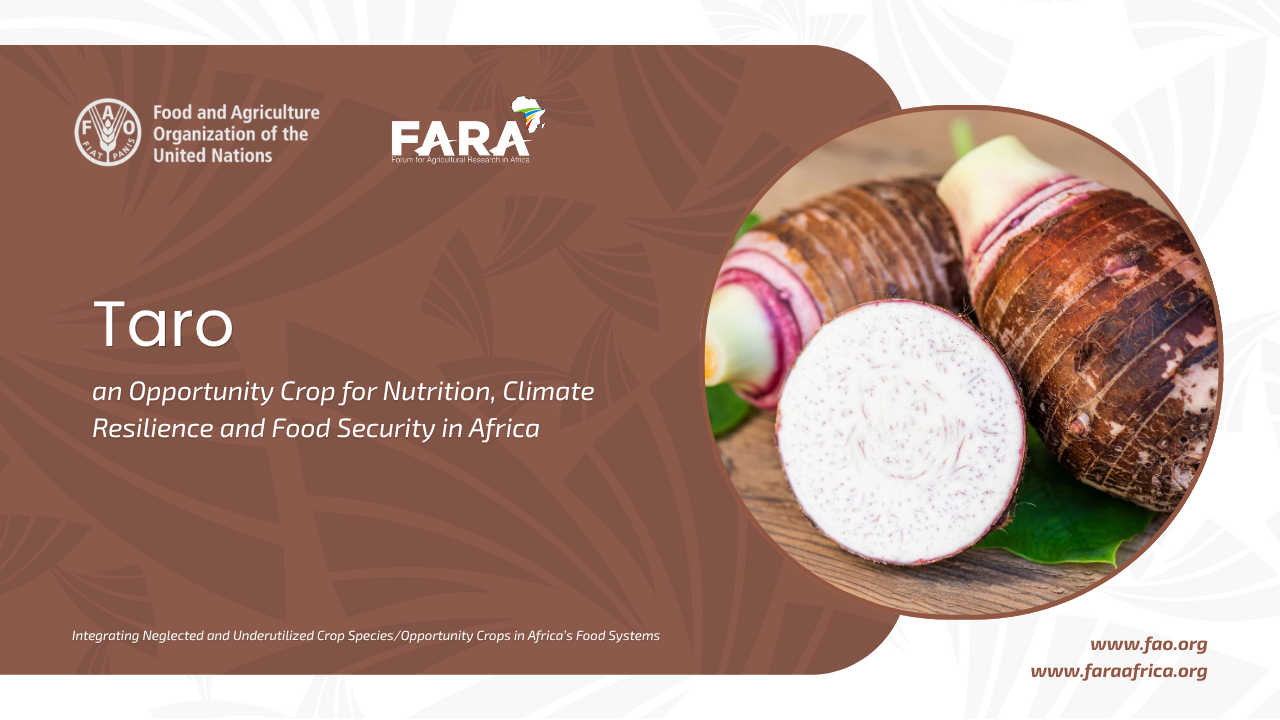
It is easy to overlook Taro. Its rough, brown exterior does little to advertise what is underneath, and its name changes depending on where you encounter it. Yet Colocasia esculenta is one of the world’s oldest cultivated root and leaf crops, with a history stretching across continents (Ahmed et al., 2020).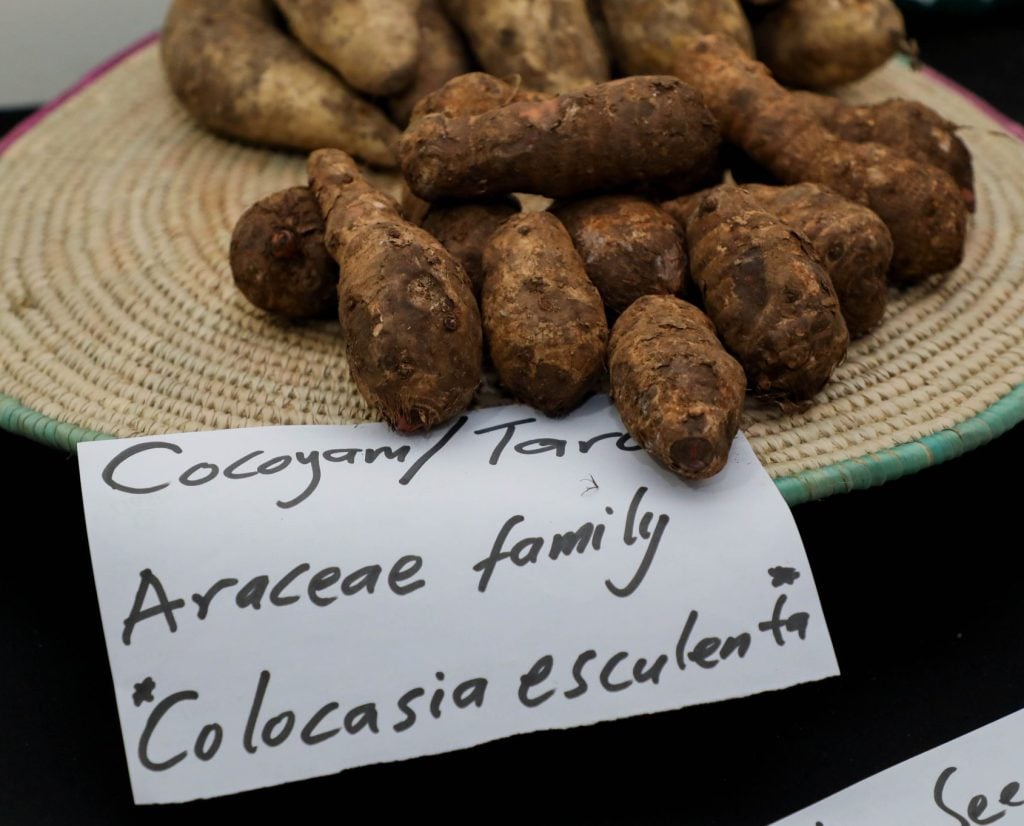
Its evolutionary origins are associated with Southeast Asia, though its exact domestication story is more complicated than a single point on a map. Genetic research shows cultivated taro has multiple lineages that appear to originate in Southeast Asia, while archaeological evidence points to early cultivation or use in places like Papua New Guinea, though the same genetic evidence argues against Papua New Guinea itself being where taro was first domesticated (Ahmed et al., 2020).
By the time of the Columbian exchange, taro was already spread across tropical Africa, Asia, Oceania, and the Mediterranean, and it remains an important food crop across the tropics today. Even the name can send you in several directions. Taro is Colocasia esculenta, but in parts of Africa “cocoyam” refers to both taro and Xanthosoma species — botanically different crops that often sit side by side in the same market.
What taro does have in common across food cultures is versatility. The corm can be boiled, steamed, baked, roasted, fried or mashed, or dried and milled into flour for baked and processed foods. Its leaves are eaten as vegetables too, giving the plant two distinct food uses from one crop.
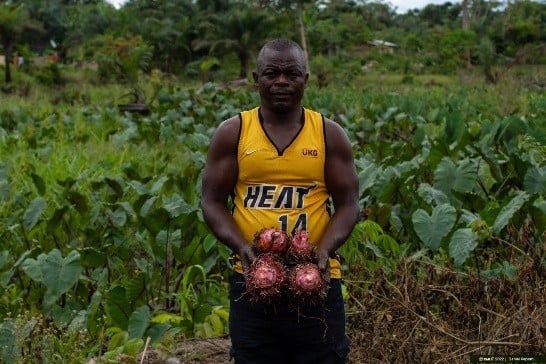
What’s actually inside it? According to the FAO/INFOODS Food Composition Table for Western Africa, 100 g of raw taro corm provides about 127 kcal, 2.7 g of protein, 25.2 g of available carbohydrate and 4.1 g of dietary fibre, plus 26 mg of calcium, 1.6 mg of iron and 0.61 mg of zinc. The leaves are nutritionally different: 39 kcal, 2.5 g of protein, 5.6 g of fibre and 190 mg of calcium per 100 g (Vincent et al., 2020).
The leaves deserve their own moment, too. Beyond that base profile, taro leaves are a strong source of vitamin A and vitamin C; a single cooked cup (about 145 g) covers roughly a third of a day’s vitamin A and over half a day’s vitamin C, plus useful folate and potassium (Healthline, 2023). They’re also valued for their iron — in Ghana, taro leaf is anecdotally believed to help improve iron status, and a Ghanaian study did find taro leaves testing markedly higher in iron than every other common leafy vegetable it compared, though measured on a dry-weight basis (Amagloh & Nyarko, 2012). A separate 2019 review found iron levels ranging more widely still, from 3.4 to 11.7 mg per 100 g across the studies it examined, tying that spread to differences in variety, climate and growing conditions (Gupta et al., 2019) — useful iron, but not one number every study agrees on. That’s real micronutrient density for a low-calorie green, and it’s why taro leaves already anchor dishes from West Africa’s kontomire stew to the Pacific’s palusami, independently of the corm. One caution: raw taro leaves contain calcium oxalate crystals, which irritate the mouth and throat — hence the need to cook them thoroughly rather than eat them raw, a rule cooks have followed for generations (Healthline, 2023).
So how does taro compare with yam and cassava — two staples many African consumers already know? The table below uses the same FAO/INFOODS Western Africa 2019 dataset for all three raw edible portion.
Nutritional comparison of Taro, Yam and Cassava
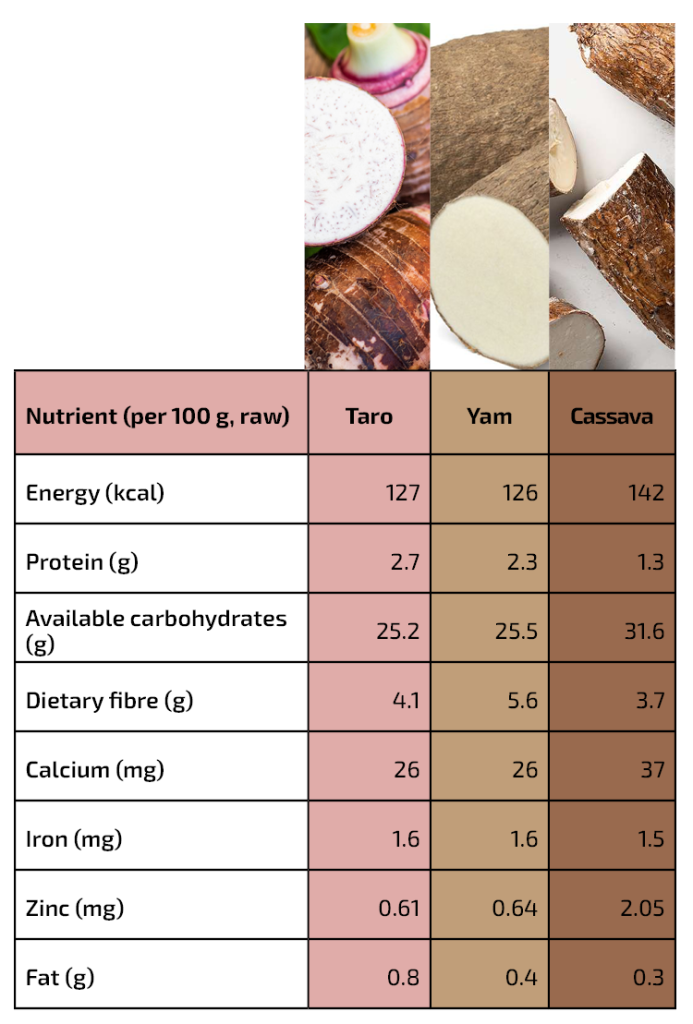
Source: FAO/INFOODS Food Composition Table for Western Africa, 2019, reproduced in the FAO/FARA Compendium of Forgotten Foods in Africa. Taro food code 02_015; yam 02_019; cassava 02_001.
There’s no champion here, and that’s the point. Cassava wins on carbohydrate and calcium, yam on fibre; taro sits between them and edges ahead on protein. That’s not a case for one crop replacing another; it’s a case for keeping all three on the plate.
Taro itself isn’t nutritionally uniform either — the same kind of variation just seen in its leaves shows up across the whole plant. A 2019 study of 18 taro genotypes in Ghana found significant genotype-to-genotype variation in protein, carbohydrate, fibre and mineral content, including calcium and iron (Boampong et al., 2019). “Taro” isn’t one fixed nutritional profile; it’s a crop with genetic diversity that matters to farmers, breeders and food processors alike.
So why should someone actually reach for taro? If you’ve ever ordered taro milk tea or a taro-flavoured snack, you’ve already met the flavour; just not necessarily the root. Much of the vivid purple “taro flavour” sold in bubble tea shops is purple sweet potato or food colouring; real taro, cooked, is pale beige to light purple, with a subtly sweet, nutty flavour and faint vanilla-like notes (Sift & Simmer, n.d.). Taro has become one of the defining flavours of the global boba boom, alongside mango and matcha, and has found its way into ice cream, popcorn, and snack aisles, particularly among younger consumers seeking new flavours (The Stripes, 2023). An entire generation already has a taste for taro. Most just haven’t met the actual root.
And the real thing offers more than flavour. Behind the familiar “taro” label is a whole food with its own nutritional character. Its fibre and resistant starch behave differently from fast-digesting sugar, which researchers link to a gentler effect on blood sugar than some other starchy staples (Tan et al., 2025). It is naturally gluten-free and provides minerals including potassium, calcium, iron and zinc, while its antioxidant compounds, including flavonoids and anthocyanins, are being studied for their potential anti-inflammatory and metabolic effects (Tan et al., 2025). None of that makes taro a superfood. It simply makes it a genuinely useful everyday ingredient, not just a nostalgic one.
And for the reader who already trusts it, taro needs little convincing. It has fed households for generations, with both its corm and leaves finding their way into the kitchen. Its value is not only in what it provides today, but in how adaptable the crop has proved to be across different food systems and environments. That’s its own kind of evidence.
So where could taro go next? Perhaps the answer lies in building on what it already does well. Its corms, for instance, can be processed into flour and starch for baked and value-added foods, and its ability to grow across wetland, dryland and shaded conditions gives it real agricultural versatility to build on. That same adaptability is already visible in how far taro has travelled — its texture and flavour carried it across Asia, Africa, the Pacific and the Caribbean long before now — and that history gives researchers and food producers another reason to pay attention today.
Taro does not need to replace yam or cassava to become more important — those crops have earned their place, and taro can occupy its own: another root crop, another food option, another source of genetic diversity, another ingredient with room for innovation. None of that means taro needs reinventing, though — after thousands of years of being carried, cultivated, and cooked across the world, it already knows what it is. It needs people to look at it again; not as an unfamiliar root waiting to be discovered, but as an old crop with plenty of life left in its story.
Prepared by: Whitney Asor Adade & Shaquille Pennaneach (FARA)
References
- Ahmed et al. (2020). Evolutionary origins of taro (Colocasia esculenta) in Southeast Asia. Ecology and Evolution, 10(23), 13530–13543. DOI: 10.1002/ece3.6958. https://pmc.ncbi.nlm.nih.gov/articles/PMC7713977
- FAO & FARA (2024). Compendium of Forgotten Foods in Africa. Food and Agriculture Organization of the United Nations. https://knowledge4policy.ec.europa.eu/publication/compendium-forgotten-foods-africa_en
- Vincent et al. (2020). FAO/INFOODS Food Composition Table for Western Africa (2019): User Guide & Condensed Food Composition Table. FAO, Rome. https://openknowledge.fao.org/handle/20.500.14283/ca7779b (data file: https://www.fao.org/fileadmin/user_upload/faoweb/2020/WAFCT_2019.xlsx)
- Boampong et al. (2019). Biochemical Characterization of Some Taro (Colocasia esculenta L. Schott) Germplasm in Ghana. Advances in Agriculture, 2019, Article 1965761. DOI: 10.1155/2019/1965761. https://doaj.org/article/c375cd4d53aa4a1c8bf60f297963da80
- Tan et al. (2025). From starch to bioactives: emerging trends in taro (Colocasia esculenta L.) research on composition, functionality, health benefits, and sustainable food potential. Frontiers in Nutrition, 12, Article 1640156. DOI: 10.3389/fnut.2025.1640156. https://www.frontiersin.org/journals/nutrition/articles/10.3389/fnut.2025.1640156
- The Stripes (2023). Boba has become a top flavor for snacks, from popcorn to ice cream. https://www.stripes.com/living/2023-07-03/boba-has-become-a-top-flavor-for-snacks-from-popcorn-to-ice-cream-10631896.html
- Sift & Simmer (n.d.). Real Taro Milk Bubble Tea. https://www.siftandsimmer.com/?p=10607
- Healthline (2023). Taro Leaves: Nutrition, Benefits, and Uses. https://www.healthline.com/nutrition/taro-leaves
- Gupta, K., Kumar, A., Tomer, V., Kumar, V., & Saini, M. (2019). Potential of Colocasia leaves in human nutrition: Review on nutritional and phytochemical properties. Journal of Food Biochemistry. DOI: 10.1111/jfbc.12878. https://onlinelibrary.wiley.com/doi/10.1111/jfbc.12878
- Amagloh, F.K. & Nyarko, E.S. (2012). Mineral Nutrient Content of Commonly Consumed Leafy Vegetables in Northern Ghana. African Journal of Food, Agriculture, Nutrition and Development. https://agris.fao.org/search/en/records/68514ae8aab9439e79fc0249
Join the continental discussion on Opportunity Crops/Forgotten Foods/Neglected & Underutilized Crop Species via the FARA Africa Community
Relive the highlights from the Regional Consultation on Opportunity Crops in Africa via YouTube
Get a copy of the Global & Africa Manifesto on Forgotten Foods, the Forgotten Foods Compendium and the Companion Document


One Comment
Awesome, Planted some from Ghana, this year, they are growing well.