



17th September 2026,
Harare, Zimbabwe.
Research must be connected to seed systems, extension, finance and markets if Africa is to achieve the Kampala target of increasing agrifood output by 45 percent by 2035.
The Forum for Agricultural Research in Africa (FARA) has called for urgent investment in the systems required to move proven agricultural technologies beyond research stations and pilot projects and into the hands of millions of African farmers.
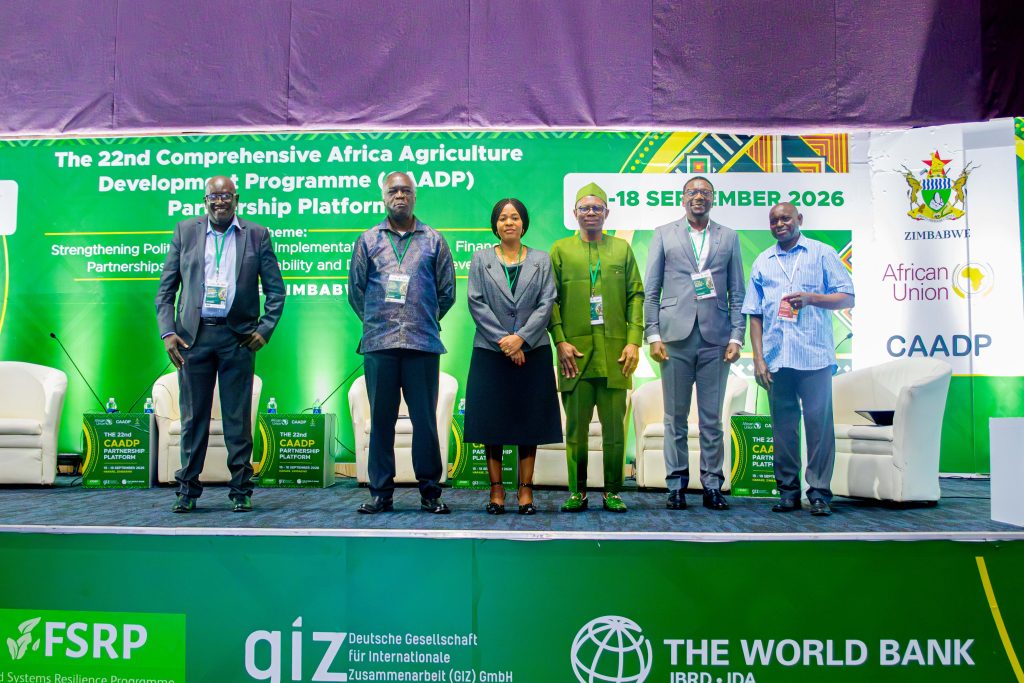
Speaking during the Sustainable Food Production session of the 22nd CAADP Partnership Platform, FARA’s Monitoring, Evaluation and Learning Lead Specialist, and coordinator of the Common African Agro-Parks Programme (CAAPs) Anselme Vodounhessi stated that Africa already possesses a substantial body of agricultural knowledge and innovation. The critical constraint, he stressed, is the weak connection between research, seed systems, extension, finance and markets.
“Africa does not lack knowledge or innovation. Our priority is to organise and finance the systems that take that innovation to scale,” Mr Vodounhessi said. “Improved technologies must reach farmers in forms they can access, afford and use.”
Closing the technology deployment gap
FARA drew attention to the persistent gap between the formal release of improved technologies and their use in farmers’ fields. A major study on the diffusion and impact of improved crop varieties, covering 20 food crops in 30 countries representing approximately 85 percent of food-crop production in sub-Saharan Africa, recorded more than 3,500 formally and informally released varieties, but identified only around 1,150 improved varieties in farmers’ fields.

Mr. Anselme Vodounhessi, FARA’s MEL Lead Specialist & CAAPs Programme Coordinator
Comparing these counts provides a deployment-breadth proxy of about 33 percent, suggesting that roughly 67 percent of the released varieties were not detected in farmers’ fields covered by the study. FARA cautioned that this is a historical benchmark for crop varieties, not a current continent-wide adoption rate for all agricultural technologies. Nevertheless, it illustrates why Africa needs a harmonised system that tracks technologies from development and release through dissemination, adoption and measurable results.
A complete research-to-scale system
FARA proposed a four-part approach to connect agricultural research more effectively to delivery under the Kampala Declaration:
-
- Work with countries and Regional Economic Communities to define priority food baskets, commodities and production systems where investment can deliver the greatest gains in productivity, resilience, nutrition and trade.
- Align national and regional research programmes with these production priorities and the Kampala Strategic Objectives.
- Give every proven innovation a defined delivery pathway connecting researchers, seed producers, extension services, farmer organisations, financial institutions and market actors.
- Measure adoption and development results, including who adopts technologies, where they are used, and their effects on productivity, income, resilience and nutrition.
FARA also highlighted five priorities for implementation: aligning research with national and regional agrifood investment plans; investing in extension and other “final-mile” delivery systems; strengthening seed systems; integrating soil health, water management and climate resilience; and financing the entire innovation pathway from validation to large-scale adoption.
Financing the full innovation pathway
Financing remains one of the weakest links. Short project cycles make it difficult to sustain research programmes, infrastructure and specialised capacity. Funding frequently ends after technology development or demonstration, leaving validation, commercialisation, multiplication and adoption under-resourced. Women, young innovators, farmer organisations and local enterprises also face disproportionate barriers to suitable finance.
In response, FARA presented the Abuja Clarion Call, which emerged from the High-Level Ministerial Dialogue on Sustainable Financing for Agricultural Research and Development convened during the 2026 FARA Science Week. Commitment 3 calls for an African-led mechanism for sustainable financing of agricultural research and innovation, including an endowment mechanism that would mobilise predictable domestic public and private resources and link financing to continental and national priorities.
FARA invited the African Union Commission, AUDA-NEPAD, Regional Economic Communities, Member States, financial institutions and private-sector partners to work together to operationalise this commitment.
Three immediate actions!
To translate the discussion into delivery, FARA proposed that:
-
- Countries and Regional Economic Communities select a limited portfolio of proven, locally appropriate technologies for scaling by 2028.
- Research, extension, farmer and private-sector institutions jointly develop a delivery pathway for each selected technology, with clear responsibilities and financing requirements.
- Continental accountability systems track adoption and development outcomes—not only the number of technologies generated.
FARA further recommended that these priorities be incorporated into the Harare Delivery Compact with named institutions, defined financing routes and measurable milestones for the first 30, 90 and 180 days.


Leave A Comment