


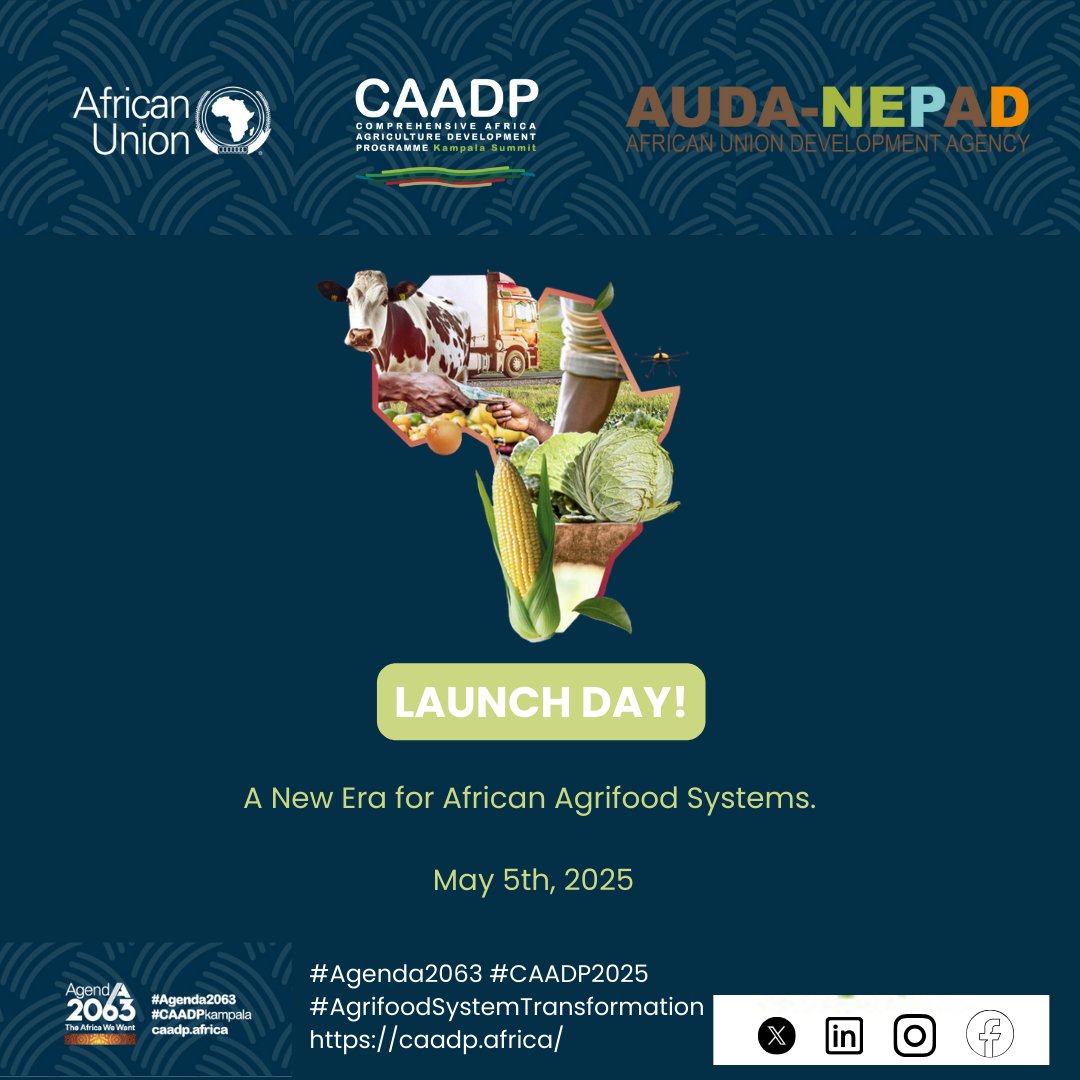
May 5, 2025 – Johannesburg, South Africa – In a landmark event held at the Radisson Hotel, Johannesburg, the African Union Commission (AUC) and the African Union Development Agency (AUDA-NEPAD) officially launched the Comprehensive Africa Agriculture Development Programme (CAADP) Strategy and Action Plan (2026–2035) and adopted the Kampala Declaration, marking a major milestone in the continent’s pursuit of agricultural transformation.
The high-level launch brought together ministers of agriculture, development partners, regional economic communities, civil society, farmer organisations, women and youth networks, and private sector representatives.
Key highlights:
- New strategic blueprint: The CAADP 2026–2035 strategy focuses on six strategic objectives, including food security, climate resilience, inclusive growth, and agro-industrialisation.
- Unified commitment: Officials from AU Member States and development partners called for bold reforms, improved intra-African trade, and increased investments in smallholder farmers.
- Voices from the field: Farmer leaders, including Ms. Elizabeth Nsimadala (EAFF), emphasized the importance of meaningful farmer inclusion, transparency, and local ownership in policy implementation.
- Science and innovation front and centre: The AARIEI Knowledge Institutions, led by FARA, pledged continued support for evidence-based planning, technology adoption, and scaling of innovations.
The launch signals the start of a transformative decade for African agriculture, driven by collective leadership, shared accountability, and a firm commitment to inclusive development.
The full CAADP Strategy and the Kampala Declaration will soon be available in English, French, Portuguese, Arabic, and Swahili.
Media Contact:
Benjamin Abugri (FARA) – [email protected]
Daniel Obloni Kweistu (FARA) – [email protected]
Bridget Kakuwa (CCARDESA) – [email protected]
Alida Nadinga (CORAF) – [email protected]
Ben Ilakut (ASARECA) – [email protected]
Grace Musimami (AFAAS) – [email protected]


11 Comments
The collaboration on the strategic adoption of eco-sustainable and thematically manageable for agri-food sustainability is commendable. We support the program 🙌.
This is great and landmark stride towards achieving sustainable and inclusive food systems transformation in Africa. Member states need to contextualise this in their countries.
I thank you all the team members very much for adopting the Kampala declaration . It is my belief that the regenerative agriculture is the way go, because the soil has been depleted by the over use of agro-chemical farm inputs,
https://www.youtube.com/watch?v=ObhDJlcyiD8
This marks the 3rd Decade of CAADP. Let’s make Africa agriculture work. Less talk, more action. Less workshops, more field work. Less reliance on patronizing donors, more reliance on own resources. No country ever developed from foreign aid. Africa cannot continue to be the laughing stock of the nations. Empty rhetorical speeches must stop. We need doers, not preachers; visionaries, not villains. Some people have been around CAADP for far too long with nothing to show. We cannot continue recycling archaic personas taking us nowhere. They must give way for new ideas that can give impetus to the Kampala Declaration. Let’s take even only 10 pilot countries sampled across Africa and show that CAADP can work!
How will African universities be included and contribute their share for its success?
Good progress in the Agriculture and Food Transformation initiatives with a focus on smallholder farmer at the centre
A very comprehensive initiative. Let’s be committed to its implementation by spelling out the ‘hows’ very explicitly.
Implementation is often undermined by fragmented institutional arrangements and weak coordination among relevant ministries and stakeholders. National Agriculture Investment Plans (NAIPs) frequently lack enforcement mechanisms and suffer from poor integration with broader national development plans. Additionally, accountability and transparency in monitoring commitments are insufficient, which weakens trust and follow-through.
This is a great initiative once again achieved. We are looking forward to having access to the document and assisting in out small way in its implementation.
Sounds good and pleasant. Waiting for more insight. Thanks to all who contributed to the work.
Great Work leadership