


By Benjamin Abugri & Shaquille Allan Pennaneach
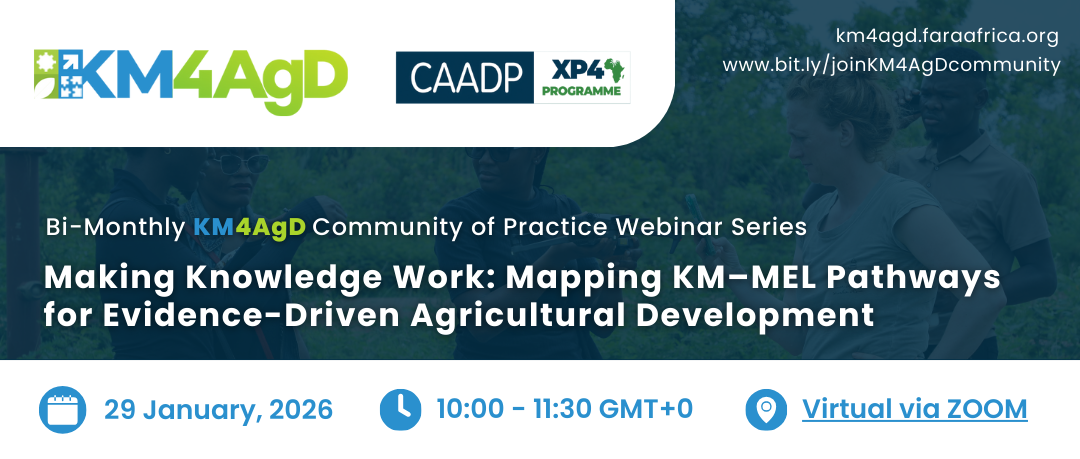
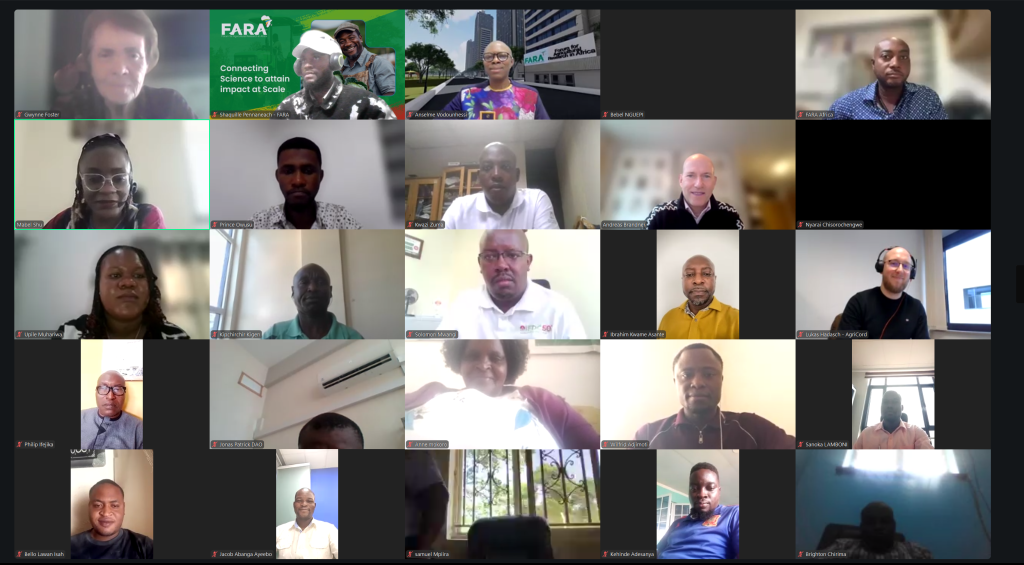
The KM4AgD Community of Practice (CoP) officially kicked off its 2026 webinar series with a highly engaging virtual session focused on strengthening the link between Knowledge Management (KM) and Monitoring, Evaluation and Learning (MEL) for evidence-driven agricultural development. The webinar, held on 29 January 2026, brought together KM practitioners, M&E specialists, researchers, policymakers, and development partners from across Africa and beyond.
Organised under the Bi-Monthly KM4AgD Community of Practice Webinar Series, the session was held under the theme: “Making Knowledge Work: Mapping KM–MEL Pathways for Evidence-Driven Agricultural Development.” The event forms part of ongoing efforts to strengthen learning, accountability, and results orientation across agricultural research and development (AR4D) systems.
Setting the Context: Why KM–MEL Integration Matters

Benjamin Abugri, KMDL Cluster Lead at FARA
Opening the session, Benjamin Abugri, Knowledge Management, Digitalization & Learning (KMDL) Cluster Lead at Forum for Agricultural Research in Africa (FARA), underscored the growing demand for robust KM systems that go beyond knowledge production to demonstrate real development results. He highlighted that while many institutions invest heavily in KM platforms, communities of practice, and knowledge products, the pathways through which these efforts translate into outcomes and impact remain insufficiently articulated or measured.
This challenge, he noted, has become particularly relevant within large multi-partner initiatives such as the CAADP-XP4 Programme, where evidence-based reporting, learning, and adaptive management are central to programme success.
Expert Insights: From Knowledge Outputs to Measurable Impact
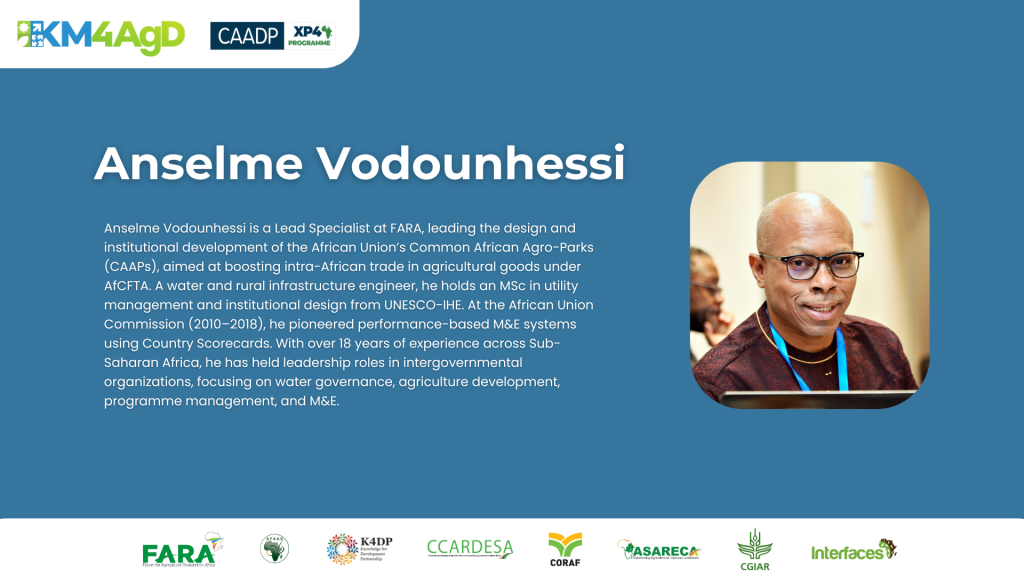
The core presentation was delivered by Anselme Vodounhessi, Lead Specialist for Monitoring, Evaluation and Learning and CAAPs Programme Coordinator at FARA. Drawing on over 18 years of experience across Sub-Saharan Africa, Anselme provided practical insights into how KM interventions can be systematically linked to results frameworks.
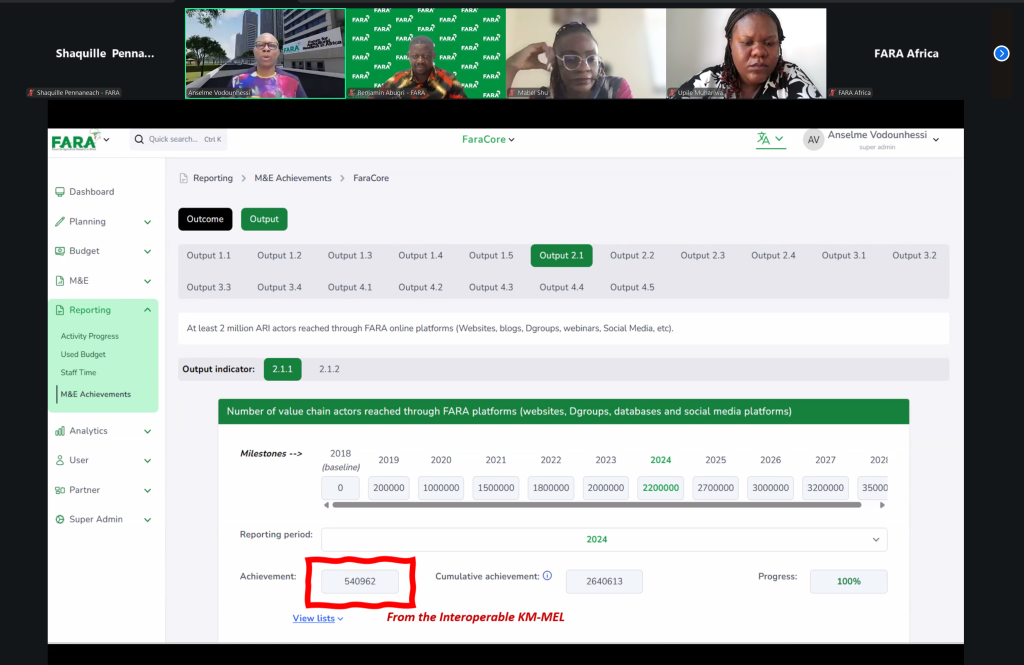
His presentation unpacked the concept of integrated KM–MEL value chains, illustrating how KM activities, such as knowledge creation, access, adoption, and use, can be mapped across inputs, outputs, outcomes, and impacts. Using real programme examples, including experiences from the CAADP-XP4 consortium, he demonstrated how institutions can move beyond counting knowledge products to measuring uptake, behavioural change, policy influence, and improvements in institutional performance.
A key takeaway was the importance of “mastering the black box” between outputs and outcomes, ensuring that assumptions, end-user positioning, and contextual factors are explicitly considered in KM results planning and reporting.
Practical Tools and Application
Participants were introduced to practical KM–MEL tools, including examples of results matrices, indicators, milestones, and dashboards used to track KM contributions to development outcomes. The session highlighted how every stage of the MEL process can serve as an entry point for KM, reinforcing the idea that KM is not a standalone function but an integral component of programme design, implementation, and learning.
These tools resonated strongly with participants working in donor-funded programmes, regional organisations, and national agricultural systems seeking to strengthen evidence generation, accountability, and learning loops.
Interactive Dialogue and Shared Learning
The presentation was followed by a lively moderated discussion led by Upile Faith Muhariwa (CCARDESA) and Mabel Lum Shu (WACSI), both Certified KM Practitioners. Participants shared reflections from their own institutional contexts, raised practical questions on indicator design and attribution, and discussed common challenges in demonstrating KM impact.
The discussion reinforced the value of the KM4AgD Community of Practice as a peer-learning space, enabling practitioners to exchange experiences, align approaches, and collaboratively refine KM practice across institutions and regions.
Looking Ahead
In closing, the session reaffirmed the KM4AgD CoP’s commitment to supporting practitioners with practical, experience-based learning that strengthens the contribution of KM to agricultural transformation. The webinar marked a strong start to the 2026 series, setting the tone for future sessions focused on knowledge co-creation, digital platforms, communities of practice, and evidence use for policy and investment decisions.
As the KM4AgD Community continues to grow, participants were encouraged to actively engage in upcoming webinars, contribute case studies, and apply integrated KM–MEL approaches within their organisations to ensure that knowledge truly works for development.
Upcoming KM4AgD Community of Practice Webinars in 2026
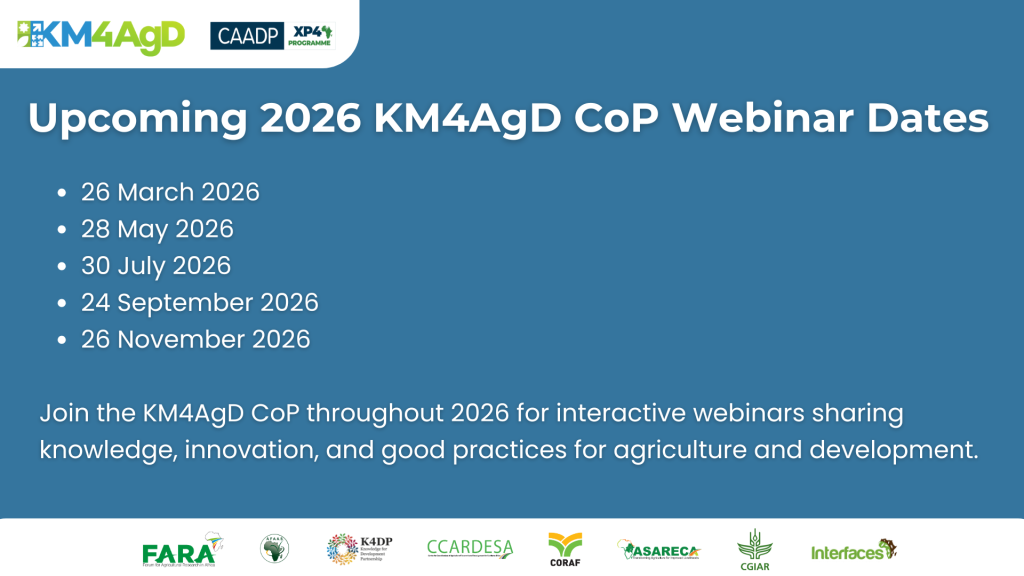
Building on the momentum of this first 2026 session, the KM4AgD Community of Practice will continue to convene bi-monthly interactive webinars throughout the year. The upcoming sessions are scheduled for 26 March, 28 May, 30 July, 24 September, and 26 November 2026. These webinars will provide ongoing opportunities for practitioners, policymakers, researchers, and development partners to exchange knowledge, explore innovative approaches, and share good practices that strengthen agricultural development and evidence-informed decision-making across Africa.
Access Making Knowledge Work Webinar – 29th January 2026 Recordings via https://bit.ly/4bkHr50


Leave A Comment