


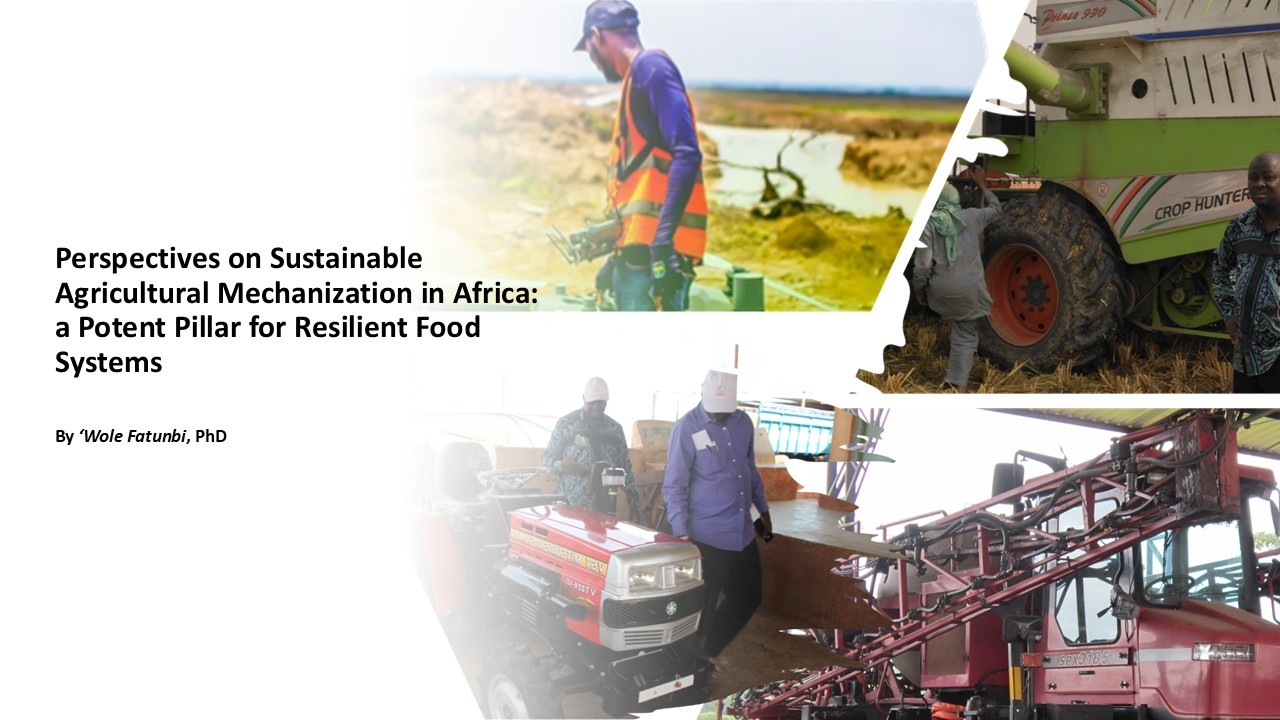
By ‘Wole Fatunbi, PhD
The Forum for Agricultural Research in Africa (FARA) is participating in the FAO-led Africa Conference on Sustainable Agricultural Mechanization (ACSAM) at the Johari Rotana Hotel in Dar es Salaam, United Republic of Tanzania, from 3 to 6 February 2026. The conference reawakened a deep reflection on the pathway to Africa’s mechanization through supportive policies and the building of local capacity.
Over the past two decades, agricultural mechanization in Africa has undergone a wavy, uneven transformation. From a landscape dominated by hand tools and animal traction, many African countries have gradually expanded the use of motorized equipment across land preparation, planting, harvesting, and post-harvest processing. The use of more advanced tools in robotics, drones, and remote sensing is gradually increasing.
This growth reflects rising labor constraints, urbanization, and the urgent need to increase productivity and resilience in food systems. Yet, mechanization in Africa today is no longer just about horsepower; it is about sustainability, inclusivity, and alignment with evolving production paradigms.
Evidence-based thinking on agricultural mechanization has been part of the FARAs’ work in the last two decades. Through coordinated research, policy engagement, and continental convening, FARA has helped reposition mechanization as a system-wide innovation challenge rather than a narrow technology transfer exercise. This vision was particularly advanced through the Program of Accompanying Research for Agricultural Innovation (PARI), a 10-year research endeavor in partnership with ZEF, the University of Bonn, and partners across 15 National Agricultural Research Institutes in Africa, which generated rigorous insights into mechanization pathways across diverse African farming systems. PARI’s work demonstrated that mechanization outcomes depend as much on institutions, service models, and user behavior as on machines themselves.
Today, Africa stands at a critical inflection point. The continent cannot afford to devolve the science of its mechanization to other developmental climes with fundamentally different agro-ecological, socio-economic, and cultural realities. While Africa does not need to reinvent the wheel, it must selectively learn from global experiences and deliberately innovate in directions aligned with its natural resource domains, farm sizes, labor dynamics, and cultural practices. Sustainable mechanization in Africa will therefore be endogenous in its scientific foundations and contextual in its applications.
Equally important is compatibility with changing production thinking. African agriculture is increasingly gravitating toward nature-based approaches such as agroecology, regenerative agriculture, climate-smart practices, and soil health restoration. Mechanization must evolve accordingly, supporting precision input use, minimum soil disturbance, residue management, and diversified cropping systems rather than reinforcing extractive or degrading practices. This shift calls for rethinking machine design, power sources, and operational scales.
FARA recently advocated for the inclusion of mechanization of the smallholder system in Africa as a pillar in the China-Africa Agricultural Science and Technology Innovation Alliance (CAASTIA) a joint research partnership between China and Africa.
The future of African mechanization also lies in advanced science and digital innovation. Remote sensing, artificial intelligence, robotics, unmanned aerial and ground devices, and smart processing technologies that offered unprecedented opportunities to overcome labor bottlenecks, improve decision-making, and reduce drudgery, especially for women and youth. Integrating these technologies into African contexts will require strong research capacity, adaptive testing, and supportive innovation ecosystems.
The long-standing debates must also be resolved with evidence rather than ideology. Concerns about heavy equipment and soil compaction on African soils remain valid in some contexts, but blanket rejection is unhelpful. Similarly, two-wheel tractors may be better suited for certain farming systems and service models, yet questions remain about their ability to support the scale of production Africa will need to meet food, feed, and industrial demand. These are scientific questions that demand African-led research and long-term experimentation.
Ultimately, sustainable agricultural mechanization is a strategic investment in Africa’s future. It requires deliberate financing of science, engineering, and innovation capacities on the continent. FARA, working with its partners, is well-positioned to lead the science and innovation component of this agenda, helping Africa mechanize not by imitation but by informed design, learning, and purposeful invention.
Note: Wole Fatunbi is the Ag. Director of Research and Innovation at the Forum for Agricultural Research in Africa (FARA). Opinions in this article are solely those of Wole Fatunbi and do not represent the position of FARA and its partners.


Leave A Comment