


Ask someone in Nairobi about “terere” or in Dar es Salaam about “mchicha”, and they will likely know how to prepare it.
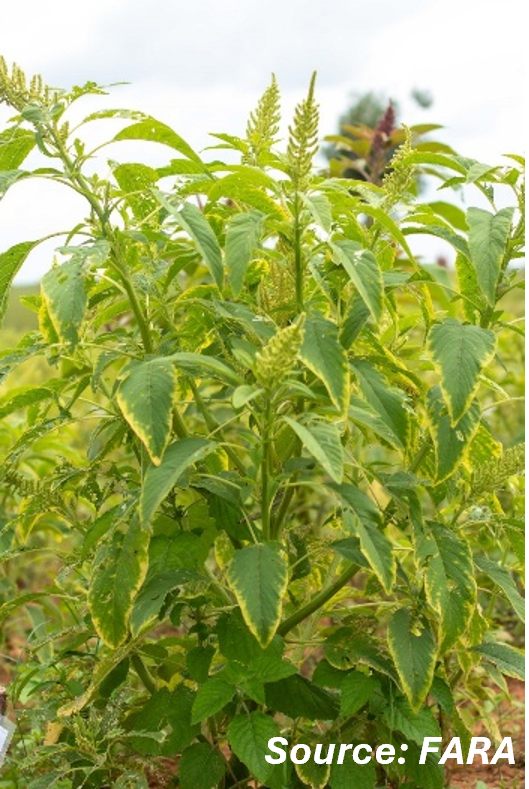
Further west on the continent, however, Amaranth (Amaranthus spp.) could be harder to find, and harder to use. A 2022 survey of Ghanaian consumers found that some respondents in southern Ghana reported amaranth as unavailable in their localities, while lack of knowledge of how to use it was also identified as a reason some respondents did not consume it (Atuna et al., 2022).
That unevenness is the real story here. Amaranth is a familiar leafy vegetable in parts of East Africa and elsewhere on the continent. In countries such as Benin, Togo and Sierra Leone, some Amaranthus species are important leafy vegetables, as they are in parts of Kenya and Tanzania (Grubben & Denton, 2004). Its familiarity varies by region, and even within countries.
Even where the leaf is well known, much less attention is given to another part of the amaranth story: its grain. Three principal grain amaranth species are Amaranthus cruentus, A. hypochondriacus and A. caudatus. Their seeds are pseudocereals, meaning they are used like cereal grains even though they are not true cereals such as maize, rice or wheat.
So what does the grain bring to the table? Amaranth grain has attracted attention for what it packs into such a small space, particularly its protein and mineral content. Here is how it compares nutritionally with two other African food crops:
Nutritional comparison of Amaranth Grain, Sesame Seeds and White Fonio
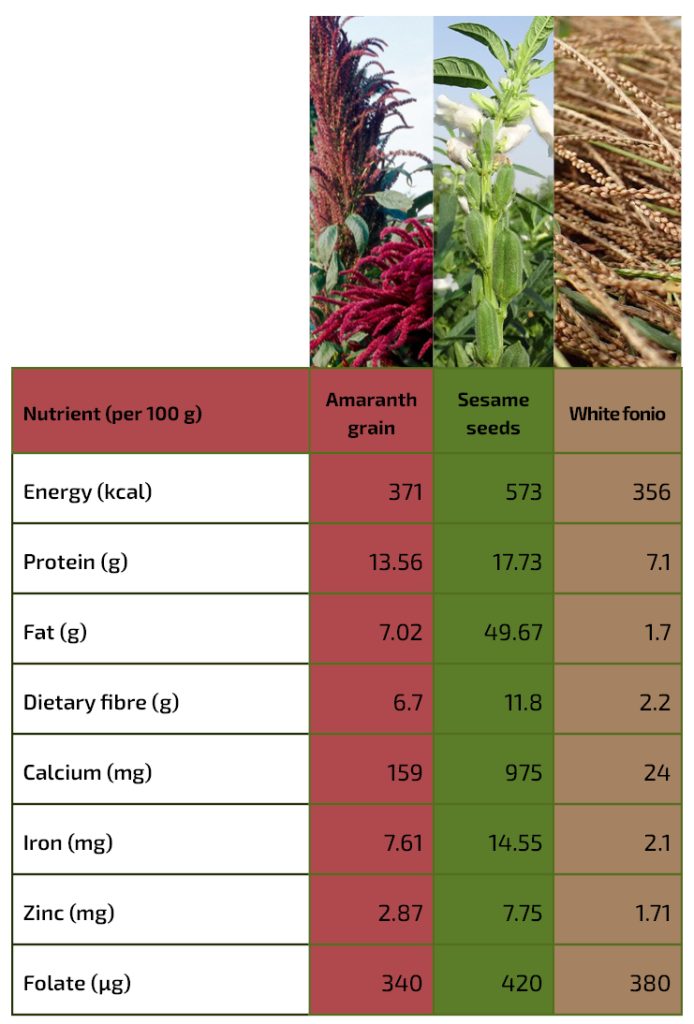
Source: Amaranth values from Caselato-Sousa and Amaya-Farfán (2012); sesame values from USDA FoodData Central (FDC 170150); white fonio values from the FAO/INFOODS Food Composition Table for Western Africa (2019). Values are for raw edible portions per 100 g. The foods are not nutritionally interchangeable: sesame is an oilseed, while amaranth and fonio are grain-like foods.
The table is not a competition between crops. Each brings different nutritional strengths. Sesame is particularly rich in fat, calcium, iron and zinc, while amaranth provides a combination of protein and minerals that makes it interesting as a grain. Fonio offers another African grain option with its own nutritional and agricultural qualities. We explored fonio’s potential in more detail in our earlier article, “The Tiny Grain with a Big Future: Highlighting Fonio’s Potential in Africa.”
Beyond the numbers in the table, amaranth’s protein quality is another point of interest. Its protein contains essential amino acids including lysine and methionine, which can be limited in some cereal proteins. Its protein profile may therefore complement cereal-based diets. How the grain is processed also matters. Studies have found that boiling whole amaranth grain can improve protein digestibility by about 15%, while boiling amaranth flour produced an increase of around 24% (Rivero Meza et al., 2023; Aderibigbe et al., 2022).
But amaranth’s nutritional value is not limited to the grain Per 100 g of fresh leaves, amaranth provides about 2.46 g of protein, 215 mg of calcium, 2.32 mg of iron and 43.3 mg of vitamin C, compared with 1.28 g of protein, 40 mg of calcium, 0.47 mg of iron and 36.6 mg of vitamin C in raw cabbage (Sarker et al., 2022). The comparison does not make cabbage less valuable; it shows why amaranth deserves more attention where it remains underused.
And the crop can fit into foods people already know. Its grains can be milled into flour, popped or incorporated into products such as porridge, bread and other baked foods. Researchers have also explored blending amaranth flour with maize and other cereals (Aderibigbe et al., 2022). For Ghana, this raises a possibility: amaranth flour could potentially be incorporated into Tom Brown, a traditional Ghanaian roasted-grain porridge, rather than asking consumers to adopt an entirely new food. This remains a proposal, not an established Ghanaian recipe.
The crop’s adaptability adds another part to the story. Amaranth can grow across varied environments, including tropical and semi-arid areas, although performance still depends on species, variety, local conditions and management. There is also a livelihood opportunity in the grain. In Homa Bay, Kenya, retired teacher Angeline Opiyo began growing amaranth in 2016 and later used a multi-grain thresher to complete threshing in less than a week. She was selling clean grain for KSh250–KSh300 per kilogram (Kilimo Trust, 2022). Her experience shows how processing tools and markets can help turn an underused crop into a source of income.
But potential alone is not enough. Research from East Africa shows that improving production without strengthening demand and market conditions generates limited economic gains (Dizyee et al., 2020). Farmers need reliable seed and buyers, consumers need foods they want to eat, and processors need workable supply chains. Simple recipes and preparation guidance could also help address the lack of knowledge about how to use amaranth identified in the Ghanaian survey.
Nutritional value alone will not make the crop succeed. But amaranth has a head start that many underused crops do not: in many African communities, people already know the plant, even if they have never met its grain. The opportunity is to build on that familiarity—by improving how the crop is produced, processed, marketed and used, while creating more value for the farmers and businesses along the chain.
Prepared by: Whitney Asor Adade & Shaquille Pennaneach (FARA)
References
- Atuna, R. A., Djah, J., Achaglinkame, M. A., Bakker, S., Dari, L., Osei-Kwarteng, M., Mahunu, G. K., Koomen, I., & Amagloh, F. K. (2022). Types of indigenous vegetables consumed, preparation, preferences and perceived benefits in Ghana. Journal of Ethnic Foods, 9, 38. https://doi.org/10.1186/s42779-022-00154-3
- Aderibigbe, O. R., Ezekiel, O. O., Owolade, S. O., Korese, J. K., Sturm, B., & Hensel, O. (2022). Exploring the potentials of underutilized grain amaranth (Amaranthus) along the value chain for food and nutrition security: A review. Critical Reviews in Food Science and Nutrition, 62(3), 656–669. https://doi.org/10.1080/10408398.2020.1825323
- Caselato-Sousa, V. M., & Amaya-Farfán, J. (2012). State of knowledge on amaranth grain: A comprehensive review. Journal of Food Science, 77(4), R93–R104. https://doi.org/10.1111/j.1750-3841.2012.02645.x
- Dizyee, K., Baker, D., Herrero, M., Burrow, H., McMillan, L., Sila, D. N., & Rich, K. M. (2020). The promotion of amaranth value chains for livelihood enhancement in East Africa: A systems modelling approach. African Journal of Agricultural and Resource Economics, 15(2), 81–94. https://doi.org/10.53936/afjare.2020.15(2).06
- FAO/INFOODS. (2019). FAO/INFOODS Food Composition Table for Western Africa (2019). Food and Agriculture Organization of the United Nations. https://www.fao.org/food-composition/tables-and-databases/detail/food-composition-tables/en
- Grubben, G. J. H., & Denton, O. A. (Eds.). (2004). Plant Resources of Tropical Africa 2: Vegetables. PROTA Foundation, Wageningen; Backhuys Publishers, Leiden; CTA, Wageningen.
- Kilimo Trust. (2022, March 27). Agri-tech helps improve smallholder livelihoods. https://www.kilimotrust.org/blog/success-stories-5/agri-tech-helps-improve-smallholder-livelihoods-106
- Rivero Meza, S. L., Hirsch Ramos, A., Cañizares, L., Raphaelli, C. d. O., Bueno Peres, B., Gaioso, C. A., Egea, I., Estrada, Y., Flores, F. B., & de Oliveira, M. (2023). A review on amaranth protein: Composition, digestibility, health benefits and food industry utilisation. International Journal of Food Science & Technology, 58(3), 1564–1574. https://doi.org/10.1111/ijfs.16056
- Sarker, U., Lin, Y.-P., Oba, S., Yoshioka, Y., & Hoshikawa, K. (2022). Prospects and potentials of underutilized leafy Amaranths as vegetable use for health-promotion. Plant Physiology and Biochemistry, 182, 104–123. https://doi.org/10.1016/j.plaphy.2022.04.011
- USDA Agricultural Research Service. (2019). Seeds, sesame seeds, whole, dried (FDC 170150; NDB No. 12023). USDA FoodData Central, SR Legacy. https://fdc.nal.usda.gov/food-details/170150/nutrients
Join the continental discussion on Opportunity Crops/Forgotten Foods/Neglected & Underutilized Crop Species via the FARA Africa Community
Relive the highlights from the Regional Consultation on Opportunity Crops in Africa via YouTube
Get a copy of the Global & Africa Manifesto on Forgotten Foods, the Forgotten Foods Compendium and the Companion Document


Leave A Comment