


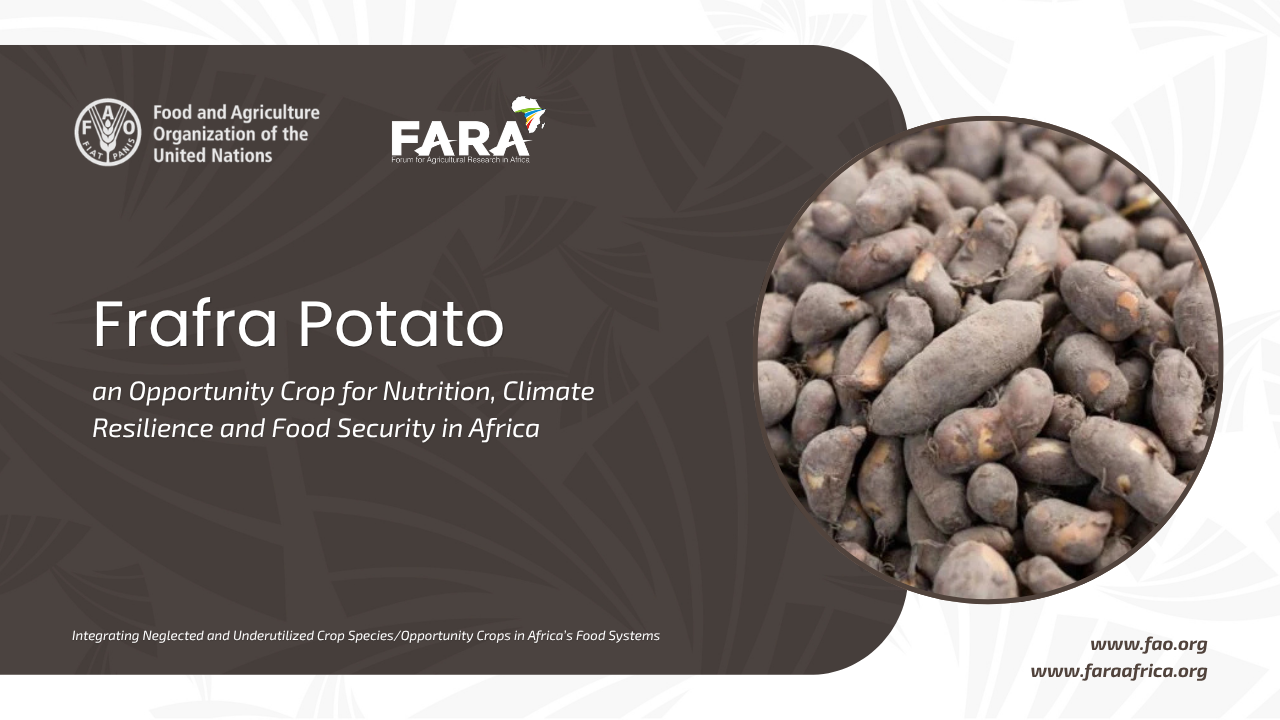
It looks like an Irish potato. It is cooked like one. But Frafra potato is more than just another potato. It has a story of its own.
Known scientifically as Solenostemon rotundifolius, Frafra potato is a tropical African tuber, with particular importance in northern Ghana and other parts of West Africa. It is also cultivated elsewhere in Africa, including parts of southern Africa, and in tropical Asia. It has many names, including Hausa potato, Sudan potato and Zulu potato, reflecting the crop’s spread across regions.
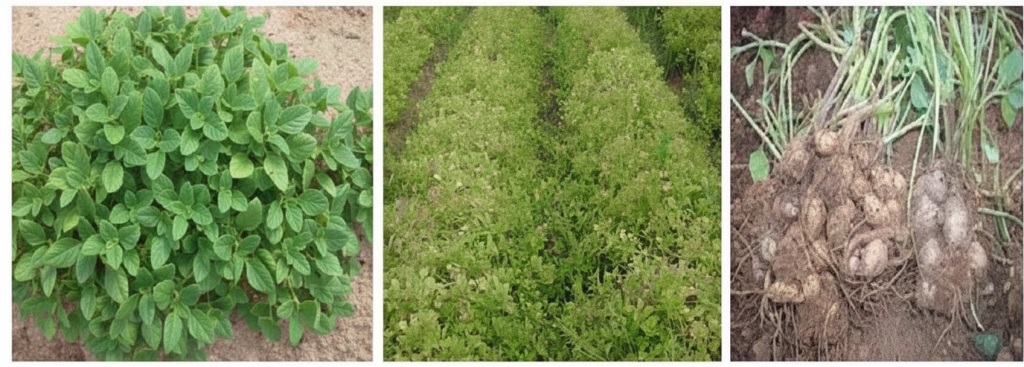
Source: Frafra potato at different growth stages in Ghana. Sugri et al. (2013).
Its tropical African origins give Frafra potato a significance beyond the communities where it is currently grown. It is part of Africa’s agricultural and food heritage, alongside many crops that receive less attention in favour of better-known staples. For Africa, keeping these crops in production and understanding what they can offer broadens the range of foods available within its food systems. For farmers in Ghana’s savannah (Northern Ghana), this wider story has a local significance. Frafra potato is already a part of local food systems and offers an option for diversifying food production. Its role in these systems makes it more than just another potato; it is part of Africa’s own agricultural diversity.
And then there is the tuber itself. Frafra potato is primarily an energy-giving food, with carbohydrates at the heart of its nutritional profile. The FAO’s Food Composition Table for Use in Africa reports that 100 g of raw Frafra potato provides 94 kcal, 21.9 g of total carbohydrate, 1.3 g of protein and 1.1 g of fibre. The same dataset also reports calcium, iron and several B vitamins.
A comparison with better-known potato varieties puts its nutritional profile into perspective:
Nutritional comparison per 100 g of raw edible portion
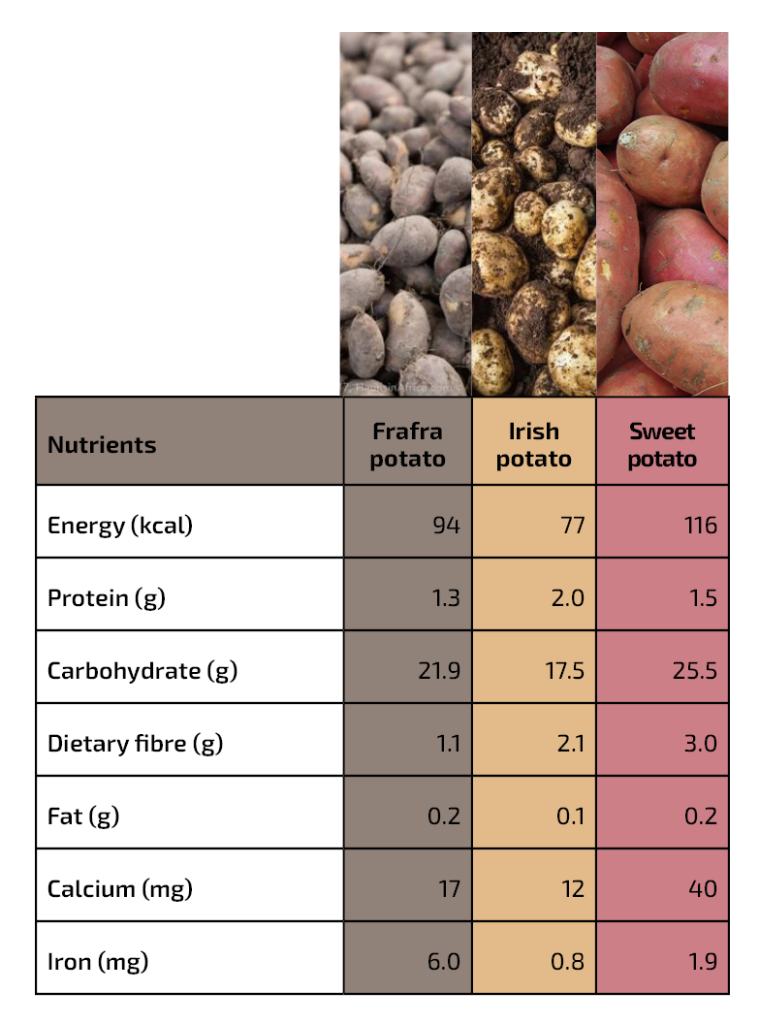
Source: Frafra potato: Leung, Busson & Jardin (1968), Food Composition Table for Use in Africa, FAO, raw Solenostemon rotundifolius. USDA FoodData Central, FDC 170026, Potatoes, flesh and skin, raw, Solanum tuberosum; data accessed via GetFoodFacts. Sweet potato: FAO, Forgotten Foods in Africa: A Compendium of Indigenous Foods and Their Nutritional Value, raw sweet potato, Ipomoea batatas.
These figures are comparative reference values reported per 100 g of edible portion. Nutrient composition can vary by variety, growing conditions and analytical methods. The complete Frafra potato dataset available for this comparison dates to 1968, so it should be viewed as a historical reference rather than a current nutritional profile of every variety.
There is, however, a gap worth paying attention to. Recent research has begun to show differences in the nutritional and functional characteristics of Frafra potato accessions, highlighting the need for updated, standardized data. For a crop with growing interest in food innovation, knowing more about what different varieties offer could help unlock its potential.
Frafra potato is not limited to traditional preparations. Its potential also extends to flour and other value-added food products. A 2024 study of flour from ten different Frafra potato types found differences in nutritional, physical and functional characteristics, including minerals such as iron, calcium, zinc and phosphorus. The researchers also identified 19 amino acids, including seven essential amino acids, highlighting the diversity that exists within the crop.
Research has also explored Frafra potato flour in gluten-free bread, showing how a traditional crop can become an ingredient in newer food products rather than remaining limited to traditional preparations.
Perhaps that is what makes Frafra potato worth watching. It does not need to be declared “better” than Irish potato, sweet potato, or any other tuber. Its value lies in what makes it distinct: an African crop rooted in traditional food systems, shaped by its growing environment, and offering nutritional and food-innovation potential.
The opportunity is not to make Frafra potato another version of what is already on the market, but to discover just how much potential lies in what makes it distinctly its own through research, breeding, and food innovation.
Prepared by: Whitney Asor Adade & Shaquille Pennaneach (FARA)
References
- Leung, W.-T. W., Busson, F. & Jardin, C. (1968). Food Composition Table for Use in Africa. Food and Agriculture Organization of the United Nations (FAO). FAO Food Composition Table for Use in Africa
- USDA Agricultural Research Service. FoodData Central. FDC 170026, Potatoes, flesh and skin, raw, Solanum tuberosum. USDA FoodData Central, GetFoodFacts — Potatoes, flesh and skin, raw (FDC 170026)
- FAO & FARA. Forgotten Foods in Africa: A Compendium of Indigenous Foods and Their Nutritional Value. Food and Agriculture Organization of the United Nations. FAO — Forgotten Foods in Africa
- Osei Tutu et al. (2024). Physical, chemical, and rheological properties of flour from accessions of Frafra potato (Solenostemon rotundifolius). Osei Tutu et al. (2024) — University of Ghana
- Osei Tutu et al. (2024). Application of Frafra potato (Solenostemon rotundifolius) flour in the development of gluten-free bread. Osei Tutu et al. (2024) — PubMed Central
- Sugri, I., Kusi, F., Adamu, R., Kanton, L., Nutsugah, S. K. & Zakaria, M. (2013). Sustaining Frafra potato (Solenostemon rotundifolius Poir.) in the food chain; current opportunities in Ghana. Journal of Plant Sciences, 1(4), 68–75. Sugri et al. (2013) — ResearchGate
Join the continental discussion on Opportunity Crops/Forgotten Foods/Neglected & Underutilized Crop Species via the FARA Africa Community
Relive the highlights from the Regional Consultation on Opportunity Crops in Africa via YouTube
Get a copy of the Global & Africa Manifesto on Forgotten Foods, the Forgotten Foods Compendium and the Companion Document


One Comment
I have never had a deep comment because I did excellent work.