


Adama, Ethiopia, February 24, 2026
By Benjamin Abugri, Abdulrazak Ibrahim, Israel Fugah [1], Bishaw Zewdie & Muhammad Imtiaz [2]
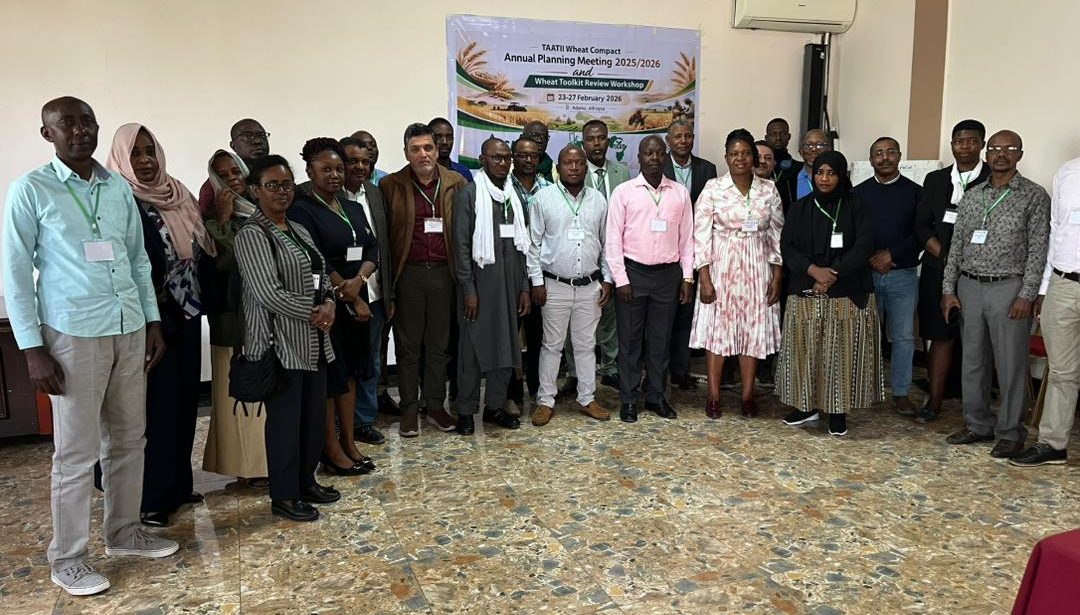
The Forum for Agricultural Research in Africa (FARA), working closely with the International Centre for Agricultural Research in the Dry Areas (ICARDA) and national agricultural institutions, has finalised a two-day regional planning workshop to boost wheat production and productivity across Africa. The meeting, held from 23 to 24 February in Adama, Ethiopia, is part of the Technologies for African Agricultural Transformation (TAAT) Wheat Compact, an African Development Bank–supported initiative designed to scale up proven agricultural technologies and lessen the continent’s heavy reliance on wheat imports.
Wheat remains a strategic crop for food security, income generation, and import substitution across many African countries. Rising demand, climate variability, and rising import bills have made it urgent to expand domestic production through improved varieties, better agronomic practices, and stronger seed-delivery systems.
The annual planning meeting, therefore, functioned as a coordination and learning platform to review implementation progress, share experiences, and collectively define priority actions for the upcoming year.
Broad Regional Participation
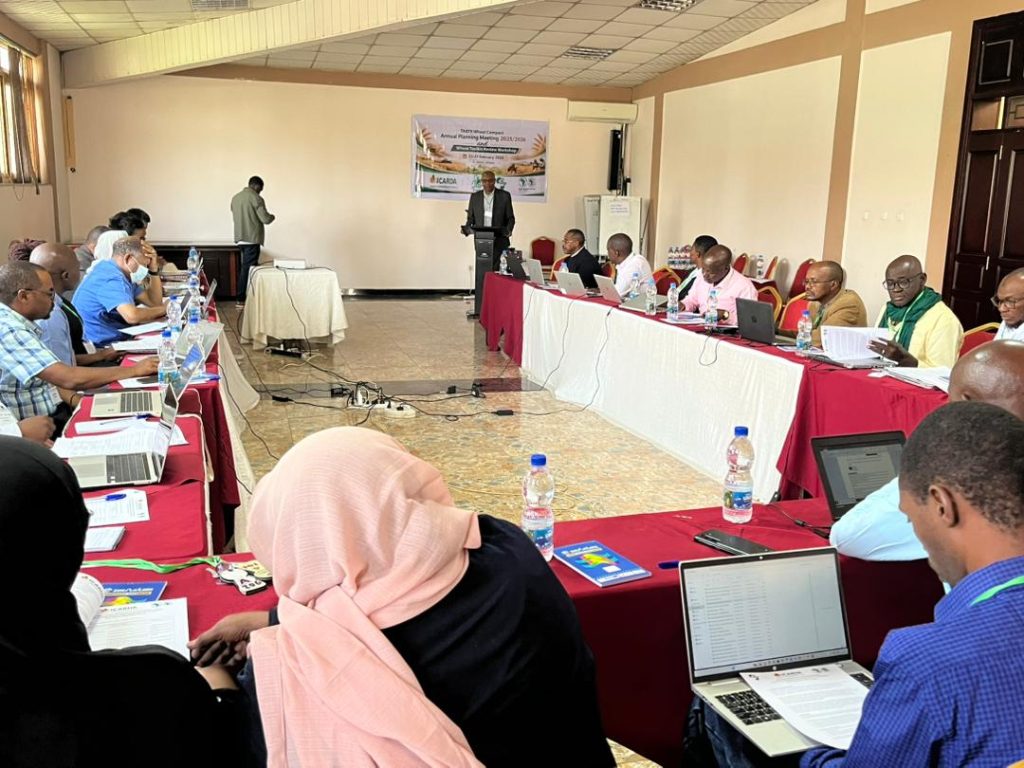
The workshop brought together technical experts and national focal persons from six participating countries, Ethiopia, Kenya, Mali, Sudan, Tanzania, and Zimbabwe, alongside TAAT technical teams, CGIAR researchers, and implementation partners. Country presentations examined production trends, seed systems performance, farmer reach, and lessons learned in scaling climate-resilient wheat technologies.
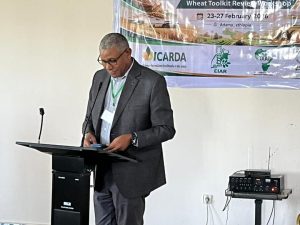
Dr Zewdie Bishaw, ICARDA
In the opening session, ICARDA TAAT Wheat Compact team coordinator, Dr Zewdie Bishaw, introduced the overall objective of the meeting: to review progress and jointly plan priority activities for the effective implementation of the Compact in the coming year. He also emphasised the importance of documenting the success stories of the Compact in target countries. The TAAT Wheat Compact partner, the Ethiopian Institute of Agricultural Research (EIAR), presented Ethiopia’s wheat self-sufficiency initiatives and the importance of science-based research in transforming national wheat systems. Plenary discussions also examined cross-cutting issues, including extension delivery, policy support, data reporting, and climate resilience.
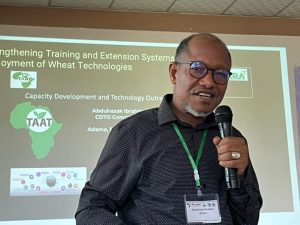
Dr Abdulrazak Ibrahim, FARA
FARA participated in the workshop as part of the TAAT Capacity Development and Technology Outreach (CDTO) Compact, represented by Dr Abdulrazak Ibrahim, Cluster Leader for Capacity Development and Future Scenarios and TAAT-CDTO Compact Leader; Mr Benjamin Abugri, Cluster Leader for Knowledge Management, Digitalisation and Learning; and Mr Israel Fugah, Data and Outreach Consultant. Their involvement focused particularly on enhancing knowledge exchange, monitoring and learning, and ensuring that lessons from participating countries are documented and shared across the continent.
FARA–ICARDA Partnership for a Food-Secure Africa
The workshop emphasised the complementary roles of ICARDA and FARA in progressing wheat productivity. ICARDA conducts research and develops technologies, including improved varieties and agronomic practices. At the same time, FARA focuses on capacity building, knowledge sharing, learning systems, and scaling across national agricultural research and extension systems.
Through this collaboration, research outputs are converted into practical knowledge for farmers, extension services, and policymakers. The method ensures that innovations progress from pilot projects to widespread adoption, thereby increasing yields and strengthening national food systems. Participants stressed that coordinated action among research institutions, governments, and regional organisations is vital for achieving sustainable wheat self-sufficiency in Africa.
By the end of the meeting, partners agreed on priority interventions, country-specific action plans, and follow-up mechanisms for the 2025/2026 crop season. The outcomes are expected to strengthen coordination and speed up the expansion of improved wheat technologies across participating countries.
Next Step: From Planning to Packaging
Following the planning workshop, participants will immediately move on to a second regional workshop from 25 to 27 February, where FARA will facilitate the packaging and dissemination of wheat Good Agricultural Practices (GAPs) developed by the TAAT Wheat Compact by the TAAT-CDTO Compact. The upcoming sessions will focus on translating research knowledge into practical extension materials and farmer-friendly guidance to support widespread adoption.
Together, the two consecutive workshops exemplify a deliberate shift from planning to implementation, connecting science, capacity development, and knowledge dissemination, and strengthening the expanding partnership among NARS, ICARDA and FARA to improve wheat productivity, reduce import dependence, and bring Africa closer to a food-secure future.
[1] Forum for Agricultural Research in Africa (FARA)
[2] International Center for Agricultural Research in the Dry Areas (ICARDA)


Leave A Comment